
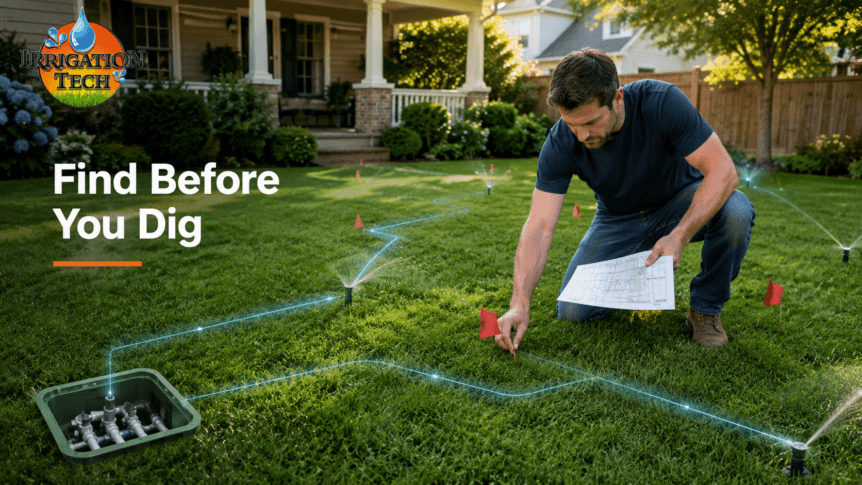
You can find the likely path of sprinkler lines without digging by reading the system layout: sprinkler heads, valve boxes, zone patterns, controller wiring, wet areas, and any old service records. The goal is not to guess where the pipe sits. The goal is to build enough confidence before planting, fencing, landscaping, or repairing the system.
Most sprinkler lines stay hidden until something goes wrong. A shovel hits a pipe. A fence post cuts a wire. A wet patch spreads across the lawn. A zone loses pressure. Locating the line path first helps protect the system and keeps a simple project from turning into a repair visit.
To find sprinkler lines without digging, start with any system map, run one sprinkler zone at a time, mark the active heads, locate valve boxes, trace the likely route between valves and heads, and verify the path with a locator or irrigation inspection when accuracy matters.
What Is the Best Way to Find Sprinkler Lines Without Digging?
The best way to find sprinkler lines without digging is to combine 5 clues: system records, visible sprinkler heads, valve box locations, zone testing, and locator tools. One clue gives a guess. Multiple clues create a useful line path.
A sprinkler line is a buried irrigation pipe that carries water through the system. A zone is a group of sprinkler heads controlled by one valve. A valve box usually marks where that zone begins.
Use this order:
- Check the system map or service records.
- Run one sprinkler zone at a time.
- Mark every active sprinkler head.
- Find valve boxes and visible water connection points.
- Trace the likely path between valves and heads.
- Verify the route before any digging or repair work.
A line tracer or valve locator can help, but the tool matters less than the interpretation. A locator may trace controller wire to a valve. It does not always map every PVC or poly pipe between the valve and each head.
That is the detail most DIY guides skip. Finding the wire is not the same thing as finding every water line.
Why Does Finding Sprinkler Lines Matter Before Yard Work?
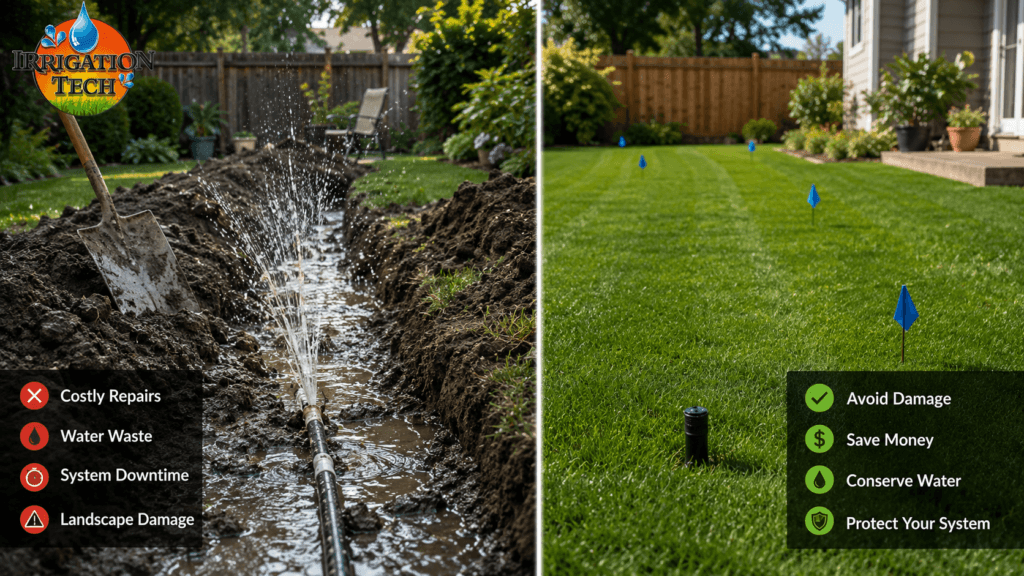
Finding sprinkler lines before yard work prevents broken pipes, cut controller wires, damaged valves, low-pressure zones, wet spots, and unnecessary lawn damage. The risk increases when a project involves digging near heads, valves, beds, fences, trees, or hardscaping.
Sprinkler lines often sit exactly where homeowners want to work: along bed edges, near walkways, beside driveways, across open lawn areas, and around planting zones. The system stays invisible until the soil opens.
Common problems start with simple projects:
- A fence post breaks a lateral line.
- A tree planting cuts through controller wire.
- A shovel cracks a shallow pipe.
- A patio project covers a valve box.
- A drainage trench crosses an irrigation zone.
- A landscape bed expansion moves soil over sprinkler heads.
A broken sprinkler line does not always show itself immediately. Some leaks appear as soft ground. Some create pressure loss. Some only show when that zone runs. Some valve or wire issues make one zone stop working completely.
If the system already has wet areas, low pressure, or a zone that will not run, the issue may connect to a leak, damaged valve, broken wire, or buried component. Irrigation Tech explains these kinds of problems in its guide on why sprinkler systems leak.
Not sure where the line runs? Irrigation Tech can inspect the system, check heads and valves, and help identify the safest next step before a repair or landscaping project.
Which Sprinkler System Parts Help You Trace the Line Path?
The sprinkler system parts that help trace buried lines are sprinkler heads, valve boxes, zone valves, controller wires, the backflow connection area, and visible wet spots. Each part gives a different clue about the hidden pipe layout.
A sprinkler system becomes easier to read when each part has a clear meaning.
| System Part | What It Tells You | Confidence Level |
|---|---|---|
| Sprinkler head | Shows where water exits the system | Medium |
| Valve box | Shows where zone piping often begins | High |
| Zone valve | Shows which group of heads is controlled together | High |
| Controller wire | Helps trace the electrical path to a valve | High for wires |
| Backflow connection area | Shows the likely water entry point | Medium |
| Wet spot | May suggest a leak, break, or low area | Low to medium |
Sprinkler Heads Show the Zone Layout
Sprinkler heads show where the system delivers water. When 4, 5, or 6 heads run together, they usually belong to the same zone. A lateral line is the pipe that carries water from a zone valve to those heads. Marking the active heads in one zone gives the first visible pattern of the buried line route. The pattern is useful. It is not proof. Pipe routes can bend around trees, patios, sidewalks, roots, and older repairs.
Valve Boxes Show Where Water Flow Is Controlled
A valve box protects the irrigation valves. A zone valve opens and closes water flow to one group of sprinkler heads. Valve boxes often sit flush with the lawn or slightly below grade. Grass, mulch, soil, landscape fabric, and groundcover can hide them. Older systems may have valve boxes that are hard to see until the turf is trimmed back. Finding a valve box matters because it often identifies the starting point for a zone.
Controller Wires Help Locate Valves, Not Every Pipe
The controller sends an electrical signal through buried wire to the valve solenoid. The solenoid opens the valve, and water moves through the pipe to the sprinkler heads.
This creates an important distinction:
- The controller wire shows the electrical path. Sprinkler pipe shows the water path.
- A wire locator can help find the valve or wire route. It does not always show the exact path of every underground pipe.
Main Lines and Lateral Lines Are Different
A main line carries water from the source toward the valves. A lateral line carries water from the valve to sprinkler heads. Main line damage and lateral line damage behave differently. A main line can leak whenever the system is pressurized. A lateral line usually leaks when that specific zone runs.
That difference helps during troubleshooting. It also helps decide whether the next step is mapping, inspection, or sprinkler repair in Rochester.
How Do You Locate Sprinkler Lines Step by Step?
To locate sprinkler lines, check records, run one zone at a time, mark every active head, find valve boxes, trace likely pipe paths, verify the route, and save the layout for future service or yard work.
Irrigation Tech defines sprinkler line locating as the process of identifying likely underground pipe, valve, and wire paths using visible system components, zone testing, locator tools, and professional verification before digging.
Use this simple field method:
| Step | Goal | Output |
|---|---|---|
| Locate | Find visible system clues | Heads, valves, controller, wet spots |
| Trace | Connect likely zone paths | Probable pipe route |
| Verify | Confirm before work begins | Lower risk |
| Document | Save the layout | Easier future repairs |
Step 1: Check the System Map or Service Records
A system map gives the fastest starting point. Look for installation drawings, property records, old service invoices, photos from installation, or notes from previous repairs. A map can show sprinkler head placement, valve locations, pipe routes, water source location, and zone layout. It can also be outdated. Repairs, additions, landscaping changes, and system upgrades can change the original route. Use the map as a guide. Verify it with the current system.
Step 2: Run One Zone at a Time
Turn on one zone from the controller. Walk the full area while that zone runs.
Watch for:
- heads that pop up
- heads that stay stuck
- weak spray
- dry heads
- bubbling water
- soft ground
- low-pressure spray
- uneven coverage
The running zone tells you which heads belong together. That group creates the first line pattern.
Step 3: Mark Every Active Sprinkler Head
Use flags, stakes, or washable marking paint. Mark every active head in that zone. Do not rely on memory. A yard with multiple zones gets confusing fast. Marking the heads makes the system visible. Use a separate color or label for each zone when possible. That keeps one zone path from blending into another.
Step 4: Locate Valve Boxes
Valve boxes often sit near planting beds, walkways, side yards, property edges, or the water supply route. Some are easy to spot. Others are hidden by turf or mulch. A valve box gives a strong clue because the lateral lines usually start from that area. Once you find the valve box and mark the heads, you can trace the likely route between them. If a zone does not turn on, the issue may be a bad valve, solenoid, wiring problem, or controller issue. Irrigation Tech’s guide to symptoms of a bad sprinkler valve can help connect those symptoms to the system.
Step 5: Trace the Most Likely Pipe Path
Connect the valve box to the active sprinkler heads. Many irrigation lines follow practical routes: straight runs, right-angle turns, and efficient paths between heads.
Real lawns create exceptions. Pipe routes can shift around:
- tree roots
- sidewalks
- driveways
- patios
- retaining walls
- utilities
- drainage lines
- old repairs
- bed expansions
A visible head pattern can suggest where a lateral line runs, but it does not prove the exact pipe location.
Step 6: Verify Before Work Starts
Verification separates a helpful guess from a safer plan. Use a wire locator, valve locator, careful inspection, or professional service when the project involves digging near a suspected line. Verification matters most before fence work, planting, hardscaping, drainage projects, or leak repairs. These projects can cut pipe, damage wires, bury valve boxes, or break sprinkler heads. For older, unmapped, or hard-to-read systems, an irrigation system inspection in Rochester gives a cleaner next step than guessing.
Step 7: Document the Layout
Documentation saves future time. Take photos from 2 angles. Sketch the zone path. Label the controller. Record valve box locations. Note wet areas and suspected repair zones. A documented system is easier to service, troubleshoot, expand, and protect.
What Tools Can Find Sprinkler Lines Without Digging?
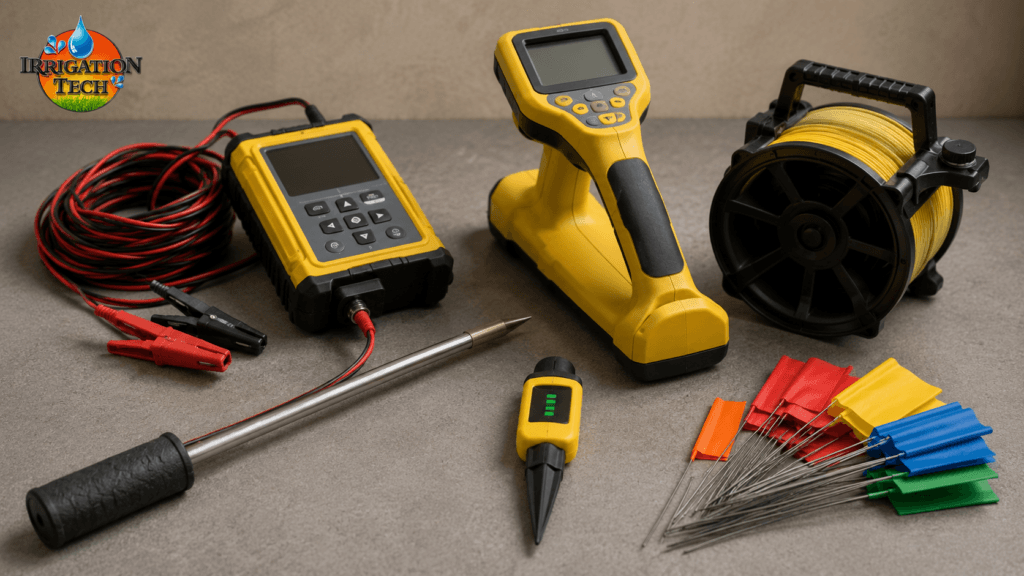
Useful tools include wire tracers, valve locators, metal detectors for metal components, cautious probe rods, marking flags, and professional locating equipment. Each tool detects a different part of the system.
The tool choice depends on the target. A buried wire, valve box, solenoid, metal lid, and plastic pipe all respond differently.
| Tool | What It Detects | Best For | Main Limitation |
|---|---|---|---|
| Wire tracer | Electrical signal on buried wire | Controller-to-valve path | Does not always trace water pipe |
| Valve locator | Valve wire or solenoid area | Buried valves and valve boxes | Needs usable wiring |
| Metal detector | Metal lids, wires, solenoids, fittings | Metal components | Poor for PVC/poly pipe |
| Probe rod | Hard objects underground | Valve box covers | Can damage parts if misused |
| Professional locator | Signals, layout clues, field symptoms | Complex or undocumented systems | Requires trained interpretation |
| Marking flags/paint | Nothing; used for marking only | Layout documentation | Not a detection tool |
Wire Tracers and Valve Locators Follow Electrical Paths
A wire tracer sends a signal through controller wire. A valve locator helps follow that signal toward the valve or solenoid. These tools work best when the controller wiring is intact. Broken, disconnected, corroded, or poorly spliced wires reduce accuracy.
The key point: a wire signal is not the same thing as a pipe route. It can lead to the valve. It does not always show each lateral line after that valve.
Metal Detectors Do Not Reliably Find Plastic Pipe
Most residential sprinkler systems use PVC or poly pipe. PVC is a rigid plastic. Poly pipe is a flexible plastic. A metal detector does not reliably trace either one.
A metal detector can help find:
- metal valve lids
- solenoids
- wire
- fittings
- old metal components
- buried metal debris
It is not a dependable tool for following plastic irrigation lines through the lawn.
Professional Tools Still Need Field Interpretation
Professional locating is not just a device scan. A technician reads the whole system: where the controller wire exits, where valve boxes sit, how heads are spaced, which zone loses pressure, and whether past repairs changed the route.
A locator can point to a wire, valve, or signal path. The technician decides whether that signal matches the water line path. When the clues disagree, the system gets inspected before the lawn is opened. That is the difference between a signal and a diagnosis.
Irrigation Tech can inspect valves, heads, controller settings, pressure issues, leaks, and suspected underground line problems as part of a practical service visit.
Can You Find PVC or Poly Sprinkler Lines Without a Locator?
PVC and poly sprinkler lines can be estimated without a locator by mapping heads, valves, and zones. Plastic pipe is harder to detect directly because it does not produce the same signal as metal or controller wire.
Plastic Pipe Requires Indirect Clues
PVC and poly lines usually require indirect locating. That means you read the system around the pipe instead of detecting the pipe itself.
Useful clues include:
- sprinkler head spacing
- valve box location
- controller zone behavior
- water pressure changes
- wet spots
- exposed fittings
- previous repair areas
- system maps
- service records
Should You Probe for Sprinkler Lines?
Probing can help find a buried valve box or shallow hard surface, but it is not a reliable way to trace sprinkler lines. A probe can damage pipe, wire, solenoids, or other buried components when used aggressively.
When Probing Helps
Probing works best when the target is likely a valve box cover. A valve box is usually a hard rectangular or round surface near the top layer of soil. Use light pressure. Stop when the probe meets resistance. Confirm carefully.
| Do | Don’t |
|---|---|
| Probe only where a valve box is likely | Probe aggressively |
| Use light pressure | Probe across the lawn randomly |
| Stop when you feel resistance | Assume resistance means pipe |
| Check carefully around the target | Use sharp force near suspected wires |
When Probing Creates Risk
Blind probing creates avoidable damage. A probe can puncture a plastic pipe, nick controller wire, damage a solenoid, or strike a buried fitting. Use probing as a careful confirmation tool. Do not use it as the main locating method.
A better path is simple: identify the zone, mark heads, locate valves, read the system pattern, and verify the uncertain area.
How Accurate Are DIY Sprinkler Line Locating Methods?
DIY sprinkler line locating methods are useful for estimating line paths. Accuracy depends on records, visible heads, valve access, wiring condition, pipe material, repair history, and how much the property has changed since installation.
DIY methods work best on newer, documented systems with visible heads and accessible valves. Accuracy drops when the system is older, unmapped, repaired, overgrown, or partially broken.
| Method | Accuracy | Best Use | Main Risk |
|---|---|---|---|
| System map | High if current | Newer documented systems | May be outdated |
| Run zones + mark heads | Medium | Estimating lateral lines | Not exact |
| Valve box tracing | Medium-high | Finding zone start points | Box may be buried |
| Wire tracer | High for wire | Locating valves/wires | Not full pipe map |
| Metal detector | Low-medium | Finding metal parts | Poor for plastic pipe |
| Probing | Low-medium | Finding valve box covers | Damage risk |
| Professional inspection | Highest | Pre-project confidence | Service cost |
Sprinkler line locating starts as pattern recognition. Heads, valves, and controller zones show a probable route. Older repairs, roots, patios, hardscaping, and rerouted zones can change that route.
That is why professional help becomes valuable when the cost of being wrong is high. A small inspection is easier than repairing a broken underground line after a project starts.
When Is It Better to Call an Irrigation Professional?
It is better to call an irrigation professional when the system has no map, buried valves, low pressure, wet spots, broken heads, unknown pipe routes, or planned digging near sprinkler components.
Call Before Landscaping, Fencing, or Planting
Professional help makes sense before projects that disturb soil near irrigation components.
Call before:
- installing fence posts
- planting trees or large shrubs
- adding a patio or walkway
- building a retaining wall
- expanding landscape beds
- adding drainage
- grading the yard
- digging near visible sprinkler heads
These projects can damage water lines, controller wires, valves, and heads.
Call When the System Is Old, Leaking, or Unmapped
Older systems carry more uncertainty. Controller labels may be wrong. Valve boxes may be buried. Repairs may have changed the route.
Call when:
- Valve boxes are missing
- Controller labels do not match the zones
- One zone has low pressure
- Heads do not pop up
- Wet spots appear during watering
- A zone will not shut off
- The system has undocumented repairs
- You cannot tell where the line runs
If a line is already damaged or leaking, sprinkler repair in Rochester is the next more direct step.
Call When You Want the System Checked, Not Just Located
Line locating solves one question: where does the system likely run?
A full inspection answers more:
- Are the heads working?
- Are valves opening correctly?
- Is pressure consistent?
- Is the controller set correctly?
- Are any zones leaking?
- Are there coverage gaps?
- Are repairs needed before the season gets busier?
For homeowners in Rochester, Monroe County, and the Finger Lakes, Irrigation Tech provides sprinkler system maintenance that helps keep the system easier to service and less vulnerable to preventable problems.
What If the Sprinkler System Has No Map?
An unmapped sprinkler system can still be traced by running zones, marking active heads, finding valve boxes, checking controller wiring, and documenting each confirmed clue. A missing map makes inspection more valuable because every finding becomes part of the new system record.
A missing map is common. Many homeowners inherit irrigation systems from previous owners. Others have systems changed by repairs, additions, or landscape work.
Start by creating your own basic map:
- Draw the property outline.
- Mark the controller location.
- Mark visible heads.
- Turn on one zone at a time.
- Label each zone on the drawing.
- Add valve box locations.
- Note wet spots or weak spray areas.
- Save photos of each zone.
This simple map helps now and later. It supports repairs, upgrades, winterization, maintenance, and future landscape work.
If the system is old, underperforming, or hard to understand, a professional irrigation system design review can determine whether the layout still fits the property.
How Can Rochester and Finger Lakes Homeowners Protect Their Irrigation System?
Rochester and Finger Lakes homeowners can protect irrigation systems by locating visible components, keeping valve boxes accessible, labeling controller zones, documenting repairs, scheduling inspections, and avoiding yard work near unknown pipe paths.
Irrigation systems in this region deal with seasonal start-ups, winterization, roots, lawn growth, soil movement, and property upgrades. A system that worked last season can still have hidden damage this season.
Older systems need extra attention. A broken line may have been repaired around a root. A sprinkler head may have been moved. A valve box may have settled below the lawn. A bed edge may now cover a pipe route.
Local service helps when mapping and repair overlap. Irrigation Tech works with sprinkler systems throughout Rochester and the Finger Lakes, including inspections, repairs, system maintenance, design, installation, and upgrades.
A good service visit does more than find one buried part. It helps make the system easier to understand, easier to maintain, and easier to protect.
What Is the Safest Takeaway About Finding Sprinkler Lines?
Finding sprinkler lines without digging requires layered evidence: maps, sprinkler heads, valve boxes, zone testing, locator tools, and careful verification. DIY methods estimate the route. Professional service helps confirm the system before damage happens.
Sprinkler line locating is not one trick. It is a process. Start with records. Mark the heads. Find the valve boxes. Run the zones. Understand what locator tools can and cannot detect. Save the layout for the next repair or yard project. A marked route is useful. A verified route is safer.
For Rochester and Finger Lakes properties, Irrigation Tech can inspect the system, troubleshoot valves and pressure issues, repair damaged sprinkler lines, and help you understand the layout before your next project.
Frequently Asked Questions About Finding Sprinkler Lines
Do sprinkler lines usually run in straight lines?
Sprinkler lines often follow logical paths between valves and heads, but they do not always run straight. Roots, sidewalks, patios, utilities, repairs, and landscape changes can alter the route.
Can a metal detector find sprinkler lines?
A metal detector can find metal parts, such as valve lids, wires, solenoids, and fittings. It usually cannot locate PVC or poly sprinkler pipe because those pipes are plastic.
Can I find sprinkler lines by running each zone?
Yes. Running each zone helps identify which sprinkler heads are connected. That zone pattern gives a probable route for lateral lines, but it does not guarantee the exact pipe location.
What is the best tool for locating sprinkler valves?
A valve locator or wire tracer is usually the best tool when controller wires are intact. It helps follow wiring to buried valves or valve boxes.
How do I know if I hit a sprinkler line?
Common signs include water bubbling from the ground, a sudden wet spot, reduced pressure in one zone, heads that stop spraying correctly, or a zone that leaks when running.