
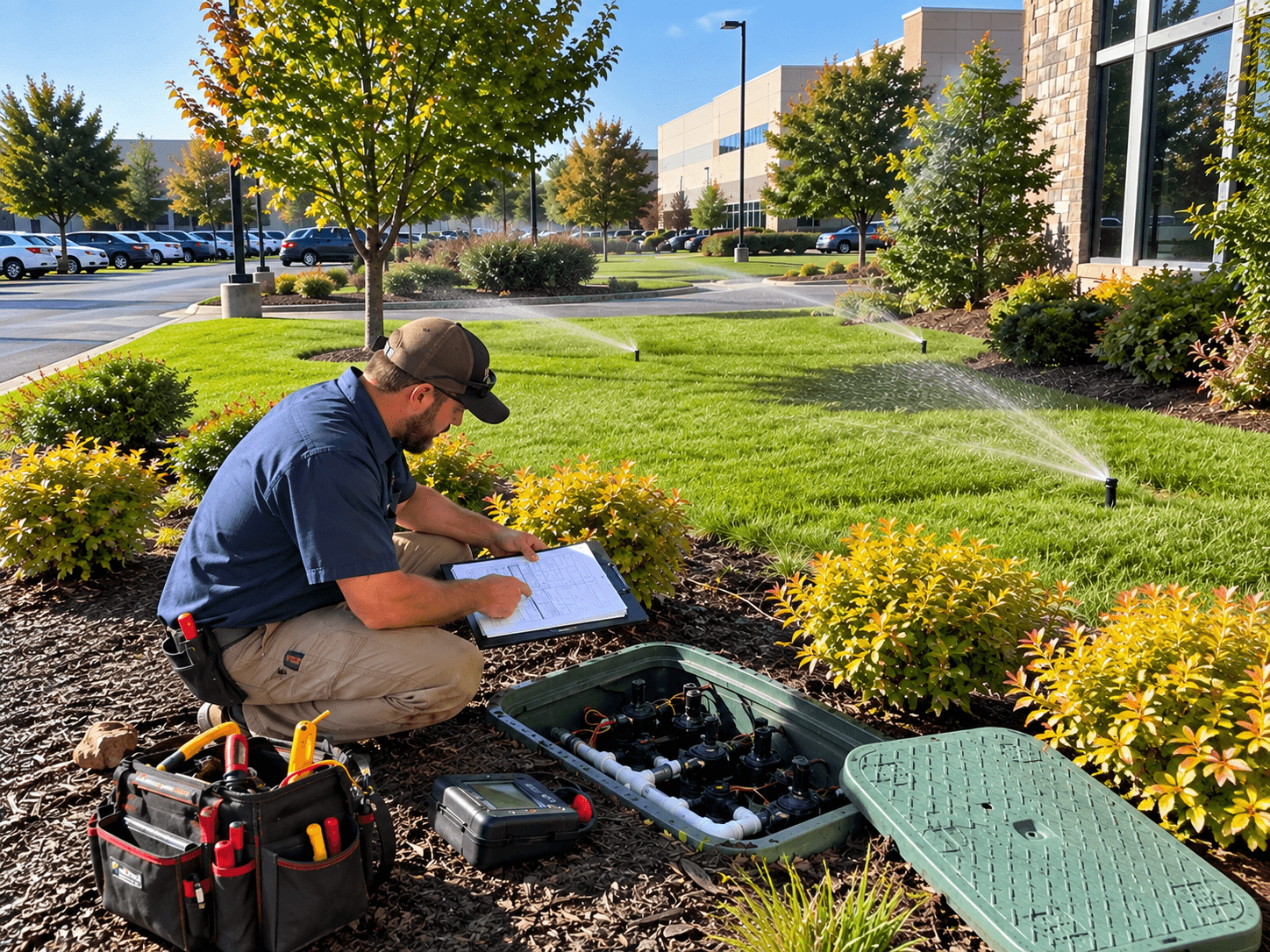
Commercial Landscape Irrigation Design and Maintenance in Rochester, NY
Irrigation Tech designs, installs and maintains commercial irrigation systems for HOAs, office parks, retail centers, schools and municipal properties in Rochester, Monroe County and nearby Finger Lakes communities. The work covers water supply analysis, system design, installation, scheduled maintenance and backflow testing, all handled by one irrigation-only company that has served this market since 1985.
Commercial Irrigation Services for Rochester Properties
Irrigation Tech covers a commercial system from the first site survey through seasonal maintenance and annual backflow testing. The four services below show what applies to a new build, an existing system or a compliance deadline.
Commercial Irrigation Design
We start with the water supply and design the system to fit it. The site survey records pressure, meter and service line capacity, and available flow. Zones are then grouped by plant demand, so turf and planting beds aren't watered on the same schedule. The result is a plan an installer can build from and the next contractor can read.
Installation for New Builds and Existing Sites
New construction, additions and full replacements all follow the approved design. On a new build, irrigation has to fit around grading, utilities and planting, so we plan the installation around those trades. On an existing site, we audit what's already in the ground before deciding what to keep.
Scheduled Maintenance Programs
Programs follow the season: spring start-up, in-season inspections and fall winterization. Each visit ends with a written report, so whoever approves the budget can see what was found and what needs repair.
Backflow Prevention and Testing
Commercial irrigation lines almost always need a backflow assembly. Our NYS-certified testers handle backflow testing and submit the test report to the water authority, so compliance doesn't depend on a second vendor.
Properties We Design and Maintain Irrigation For
A retail entrance, an HOA common area and a school field each fail in different ways. Each one gets planned around its own risks.
HOA and Multi-Family Common Areas
Entrances, common turf areas and shared beds are what residents judge first, and the board answers for every dry patch. We build programs around what a board can review: written findings and a repair list sorted by urgency.
Offices, Retail Centers and Corporate Campuses
Tenants and customers notice overspray on sidewalks, glass and parked cars. Head placement and nozzle selection keep water on planted areas, and controllers can run in overnight windows so watering never competes with foot traffic.
Schools, Municipal and Institutional Grounds
Large open turf, athletic areas and several controllers mean a lot of zones to manage. These sites also carry paperwork. Test reports, service records and system maps are kept in a form a facilities office or procurement file can use.
How We Design and Install Commercial Irrigation Systems
Every commercial system starts with thorough planning before any trenching begins.
Site Survey & Water Analysis: We measure pressure and meter capacity to set accurate flow limits, ensuring even pressure across the entire property.
Hydraulic Design & Zoning: Pipes are sized to cap water velocity at 5 feet per second to prevent water hammer, and zones are grouped by plant type and sun exposure.
Control & Safety Architecture: We integrate master valves and flow sensors that automatically shut down water supply if a line breaks overnight.
Phased Installation: Work is scheduled one zone at a time based on a pre-approved plan so your property stays open and operational during installation.
Testing & As-Built Drawings: We perform full coverage checks and provide as-built map drawings detailing exact valve and pipe locations for easy future servicing.
Backflow Prevention and Water Supply Protection
Backflow protection keeps irrigation water out of the drinking supply and it's the part of a commercial system most tied to regulation.
The sections below cover why it's required, how the device is chosen, and how testing and filing work.
Why Commercial Irrigation Needs Backflow Protection
Water sitting in irrigation pipes can pick up fertilizer, pesticide residue and soil. If pressure drops in the supply main, that water can flow backward into the drinking water system. A backflow prevention assembly stops it. It's a standard requirement on irrigation connections, and suppliers can discontinue service to sites that skip required testing. The reason comes down to protecting the drinking water supply for everyone on the main.
Matching the Device to the Hazard Level
Three assembly types cover most irrigation connections.
- Pressure vacuum breaker. Common where no back-pressure exists. It's installed above ground, higher than the highest sprinkler head.
- Double check assembly. Two check valves in series, used where the water supplier rates the hazard as low.
- Reduced pressure zone device. Adds a relief valve between two checks and gives the highest protection of the three. Many suppliers require it where a booster pump, elevated heads or multiple service lines create back-pressure.
The differences between backflow preventer types come down to the number of checks and whether a relief valve is present. The water supplier and the site's hazard level set the final choice, and requirements should be confirmed with the supplier before hardware is ordered.
Testing, Repair, Retesting and Paperwork
Assemblies are tested when installed, once a year after that, and again after any repair. A certified tester runs the test, and the results go to the water authority. Sites get caught by the paperwork more often than by the hardware, because a test that was done but never filed can trigger a notice and a repeat test. We submit the report as part of the service.
If you manage several assemblies across one site or a portfolio, send us the locations and we'll build a single testing schedule.
Commercial Irrigation Maintenance and Inspection Programs
Large systems fail in pieces. A cracked head, a stuck valve or a controller that lost its program can waste water for weeks on a site where nobody checks every zone. That's why we schedule sprinkler system maintenance as a program instead of waiting for a complaint.
Spring Start-Up
We pressurize the system, run every zone and check for breaks, leaks and heads damaged over winter. Controllers are reprogrammed for the season and the backflow assembly is inspected. You receive a written repair list with the findings.
In-Season Inspections and Adjustments
Mid-season inspection visits catch what start-up can't. Mowing changes head heights, new plantings change water demand, and weather changes run times. We check coverage, controller settings, sensors and leaks, then adjust.
Fall Winterization
Water left in a mainline freezes and splits pipe, and freezing temperatures reach Rochester every year. We blow out the system with a compressor, mainline and laterals, before the first hard freeze.
Why Property Managers and Facility Teams Choose Irrigation Tech
Hiring for a commercial site comes with a familiar set of worries, from water supply and compliance to missing records and reporting. Each point below starts with the concern and shows how we handle it.
- You need a design that fits the actual water supply. Pressure and gallons per minute are planned before a single head is placed, and CAD design puts zones, pipe runs and valves on paper before installation starts.
- You can't afford a vendor who does irrigation on the side. It's the only thing we do, and we've done it in Rochester since 1985.
- You don't want to coordinate three contractors. Design, installation, certified backflow testing and report filing sit with one company. That means one contact for scheduling and one set of records.
- Your system has no records and the last contractor is gone. We service systems installed by others. The first visit is a walk-through where we trace the zones, valves, lines and wiring and build the map the site never had.
- You answer to a board, a district or tenants. Reports are dated and written, and repairs are ranked by urgency, so you always have something to forward.
- Scale isn't a problem. We serve nearly 2,000 properties, including large commercial and institutional sites.
Commercial Irrigation Questions Answered
If you're planning a new system, replacing an old one or looking for a maintenance program, call (585) 225-0380 or send your property details through the contact page.