
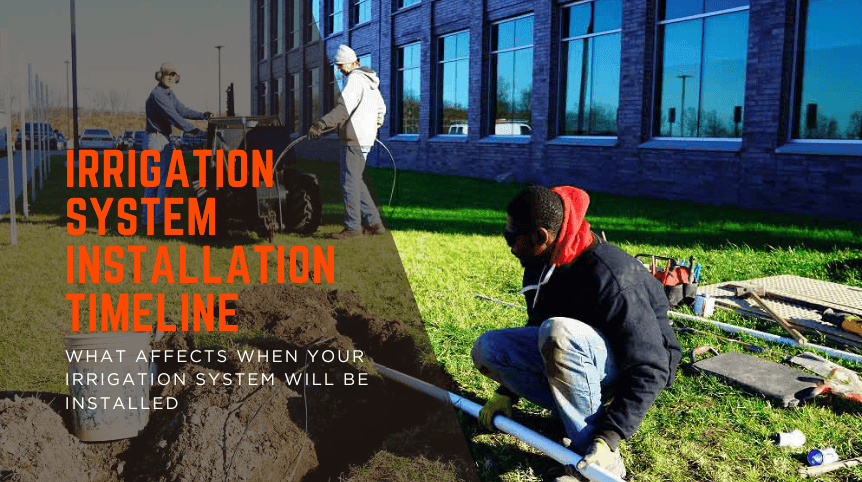
Every customer wants to know:
When will my irrigation system installation begin?
It’s a fair question. We build our installation schedule months in advance and use decades of experience to inform the custom-built software tool that helps us estimate how long each installation will take to complete. We then place the job into a calendar schedule and hope for the best because we’re optimists who expect more sun than rain.
Most of the time, we’re not too far off.
But if you’ve ever heard the saying, man plans. God laughs; you already know that even the best-laid plans don’t always unfold as expected.
Why?
Because God’s partner, Mother Nature, likes to get her hands dirty. She holds us back more often than she pushes us forward. But Mother Nature isn’t the only factor that affects our installation schedule.
Here are the variables that determine how close we’re able to come to the expected installation start and completion dates we provide.
1. Our job completion time estimate
We use custom scheduling software developed from decades of installation data to estimate how long it might take to complete your work.
Like any forecasting tool, it’s based on averages. Some jobs finish when expected, some finish sooner, and some take longer. Our schedule adjusts accordingly.
2. Your place in our schedule
Customers scheduled early in the season generally have fewer jobs ahead of them, making their scheduled installation dates more certain.
As the season progresses, even small delays on previous jobs can affect later ones.
3. Permits and utility stakeouts
All installations require backflow prevention device permits.
Permits issued by the Monroe County Water Authority rarely create a scheduling delay. Permits issued for work in the Finger Lakes and Livingston County can take weeks or months to obtain and may delay a project’s start date.
Installations in the towns of Greece and Perinton usually require you to provide plot plans and signed, notarized right-of-way forms before we can file for a permit. Once we receive those documents, it usually takes three weeks and sometimes longer for the permit to be issued. As long as we have the necessary lead time, these permits shouldn’t interfere with a projected start date.
We also can’t begin an installation until underground utilities have been located and marked through UDig NY. That’s a New York State law.
UDig NY and its member utilities often use contractors to perform this work. Depending on the volume and size of stakeout requests and the contractors’ staffing levels, some years and some areas are better than others when it comes to completing stakeouts within the allotted 10-business-day window.
If a stakeout isn’t completed on time, we may have to move on to another job for which the stakeout is complete, advancing some jobs in the schedule while pushing another one back.
4. Weather and ground conditions
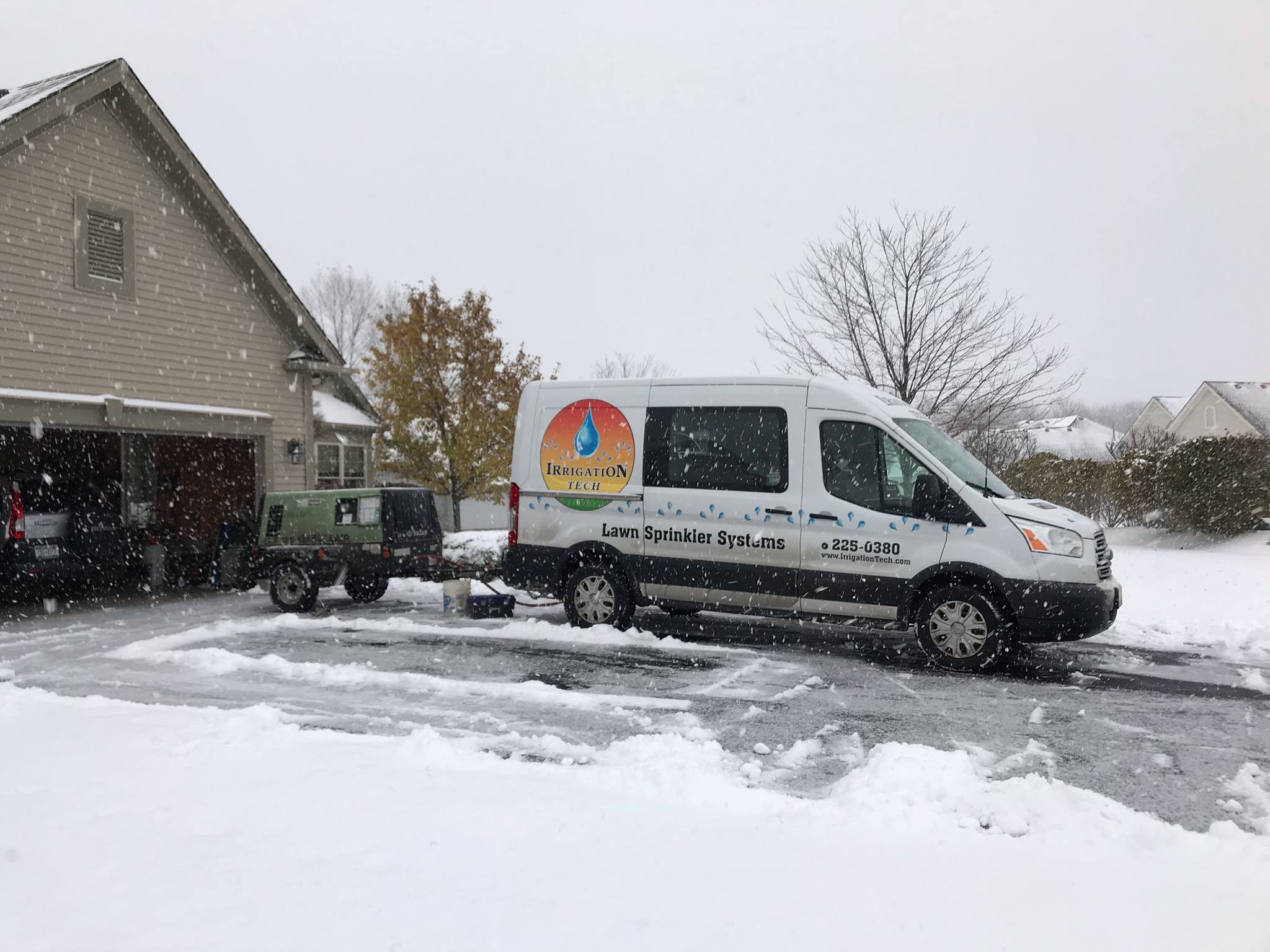
Weather, which varies greatly from year to year, plays a major role in our ability to get things done.
- A long winter can cause us to start the season later than planned.
- Excessive rain can saturate the soil so much that we can’t get our equipment onto a property or put in a full day’s work.
- A hot, dry spring or summer can slow down our crews and make the clay-heavy soils common in this area as hard as rock.
We simply can’t work as fast under these conditions as we’d like.
5. Equipment problems
Construction equipment including trucks and vans breaks down unexpectedly and inconveniently.
Although we maintain spare equipment and vehicles, taking time out to get spares or make repairs can affect our ability to perform as planned, an may push each subsequent job a little farther out into the year.
6. Other contractors
Many of our jobs follow work performed by builders, landscapers, pool contractors, or hardscape installers.
If another contractor finishes later than expected, we can’t begin our work until theirs is done. As a result, we may have to postpone our work and bring other jobs forward.
7. Changes to the work
Sometimes homeowners decide to expand or reduce the proposed scope of work shortly before we arrive on site or while we’re there.
Those changes can affect the time required to complete the work, our overall installation schedule, and when we can move on to the next job.
8. Customer schedule changes
Life happens. If a customer needs to postpone an installation, we try to fill the opening with another job or move others forward so that our crews have work to do.
Those changes affect the timing of other installations.
9. Crew availability

Some weeks, we have more technicians available than expected. Other weeks, illness, vacations, or personal emergencies reduce the size of our crew.
More people generally means faster progress, although there’s a limit to how many techs can be productively employed on any one job. Fewer people can mean that the work takes longer to complete than planned.
10. Surprises
These are probably the biggest wildcards.
Sometimes, when we arrive on site, we find landscaping, hardscaping, pools, additions, or other structures that weren’t there or have changed since we prepared our proposal months earlier or during the prior year. These changes can alter the scope of work and the time required to complete the job.
And because most of our work takes place underground, we don’t always know what’s waiting for us until we start digging.
We may encounter:
- buried pipes or wires that weren’t marked or detected by our line-tracing tools;
- rocks of all sizes;
- extensive tree roots, including roots from trees that are long gone; or
- changes in water pressure that require an additional zone or booster pump for the system to work properly during periods of peak use.
When that happens, we deal with the hand we’re dealt. That sometimes extends the time required to complete the work, but it helps ensure that the system performs as intended for years to come.
We keep you informed
We understand that you may be coordinating our work with other property-improvement projects. While no contractor can eliminate every scheduling variable, we work hard to anticipate them, communicate with you, and keep your installation moving forward.