
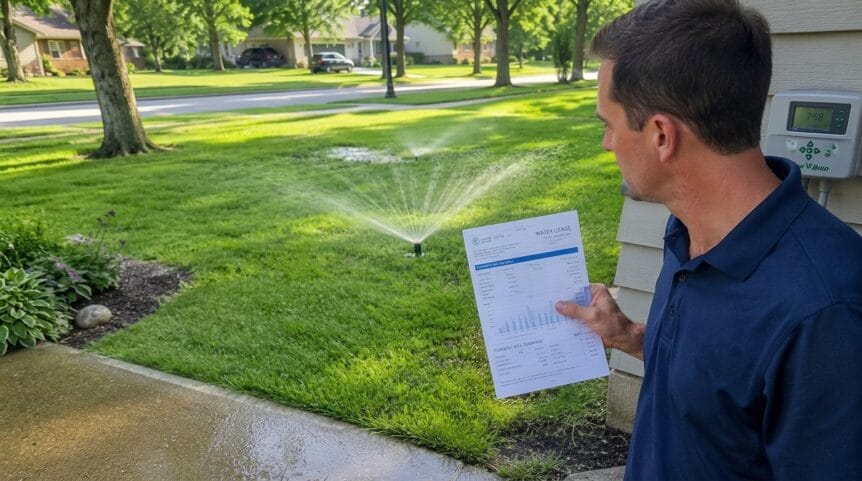
Sprinklers can push a water bill up, but it’s rarely the system itself causing it. Usually it’s a leak, a head pointed the wrong way, or a watering schedule nobody’s adjusted since spring. Monroe County Water Authority charges $4.39 per 1,000 gallons for the first 125,000 gallons each month, and a leak running quietly for a few weeks adds up fast at that rate.
What’s Actually Driving the Increase
Routine lawn watering on a fixed timer rarely explains a massive utility spike. When consumption jumps aggressively, your first step should be scheduling a comprehensive irrigation system inspection to isolate subterranean errors before municipal tier rates compound your costs. While a spray head misaligned by a commercial lawnmower or displaced by early spring frost heave can easily waste water on concrete paths, the issues that drastically alter your monthly statements happen entirely out of sight.
1. Underground Leaks (The Dime-Sized Drain)
The most frustrating issues happen entirely below the surface. According to data from EPA WaterSense (an organization we partner with directly), an underground leak the width of a dime wastes roughly 6,300 gallons of water per month.
In Western New York, these issues rarely stem from manufacturer defects. Instead, frost heave from our brutal winters shifts the soil, causing cracked lateral lines, stressed fittings, or cracked valve bodies. Over time, tree roots can also pinch or puncture lines. Because our soil can absorb a surprising amount of water before pooling at the surface, these line breaks can run silently for months. Understanding why systems leak is the first step toward stopping the financial drain.
2. A Silent Leak During a Quiet Season
A leak like this doesn’t need the system running constantly to cost you money, and a stretch of rain makes it easier to miss. When the system sits idle for weeks because the lawn’s already getting enough water from the sky, a cracked lateral line or a stuck valve doesn’t pause along with it.
That’s how a leak can run quietly through an entire wet season with nobody noticing anything on the lawn. The soil’s already saturated from the rain, so a little extra water disappearing underground doesn’t show up as a soggy patch the way it would in a dry month. The first sign often isn’t the yard. It’s the bill, arriving weeks later, for water nobody remembers using.
If your system’s been running on and off with the weather and your last bill looked off, have a technician run a quick diagnostic before another rainy week hides the problem further.
3. A Schedule Nobody’s Touched Since Spring
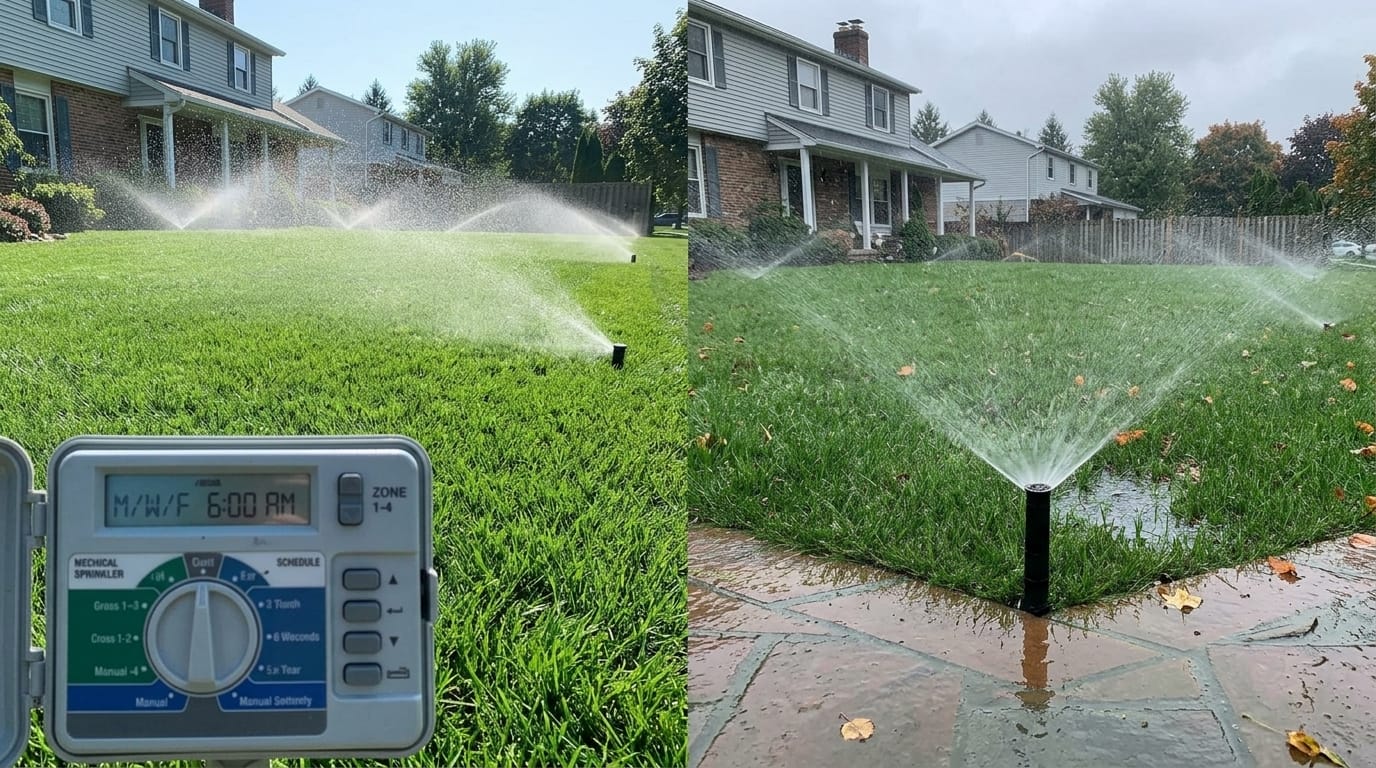
Lawn hydration requirements change dynamically between May and September. A watering schedule that keeps a lawn green during a scorching July heatwave will actively flood your property during a rainy autumn.
Leaving your controller on peak-summer settings during cooler blocks of the season is pure waste. Making a few strategic adjustments or focusing on improving watering efficiency can slice hundreds of dollars off your seasonal utility costs without sacrificing the health of your turf.
Is It the Yard or the House?
Before blaming your grass, rule out interior plumbing issues. A running toilet flapper or a water softener stuck in a continuous backwash cycle uses water at almost the exact same steady rate as an irrigation line break.
To isolate the issue, find your main water meter (typically located in your basement utility area or near the street) when no one is using water inside the house. If the low-flow indicator dial is spinning while your home appliances are idle, you have a leak.
To determine if it’s an exterior issue, shut off the dedicated main isolation valve for your sprinkler system. If the meter stops spinning entirely, the problem is officially in the yard. From there, you can attempt to trace underground lines to spot the saturated soil patch, or call in professional diagnostics.
What Water Waste Costs in Monroe County
The Monroe County Water Authority (MCWA) applies a two-tiered utility rate structure to residential properties across Pittsford, Brighton, Fairport, and Penfield. Under this billing framework, local homeowners pay a baseline rate of $4.39 per 1,000 gallons for the first 125,000 gallons used each month. If consumption passes that 125,000-gallon mark within a single billing cycle, the volume rate drops to $3.13 per 1,000 gallons for any additional water.
When an underground line fractures or a zone valve sticks open, these specific local metrics transform minor mechanical defects into high utility liabilities. For instance, a cracked lateral line leaking at a modest 10 gallons per minute wastes over 30,000 gallons of water if it runs completely unnoticed for three weeks. At the standard MCWA baseline tier, that single hidden malfunction manifests as an extra $131.70 in pure waste on your next statement.
These calculations change depending on your exact municipal boundary lines. The City of Rochester operates an independent water department with a completely separate rate schedule. Additionally, several outlying towns within our 8-county Western New York footprint route billing through separate local authorities rather than MCWA. Your baseline financial exposure ultimately depends directly on the utility provider tied to your ZIP code.
When to Bring in an Expert
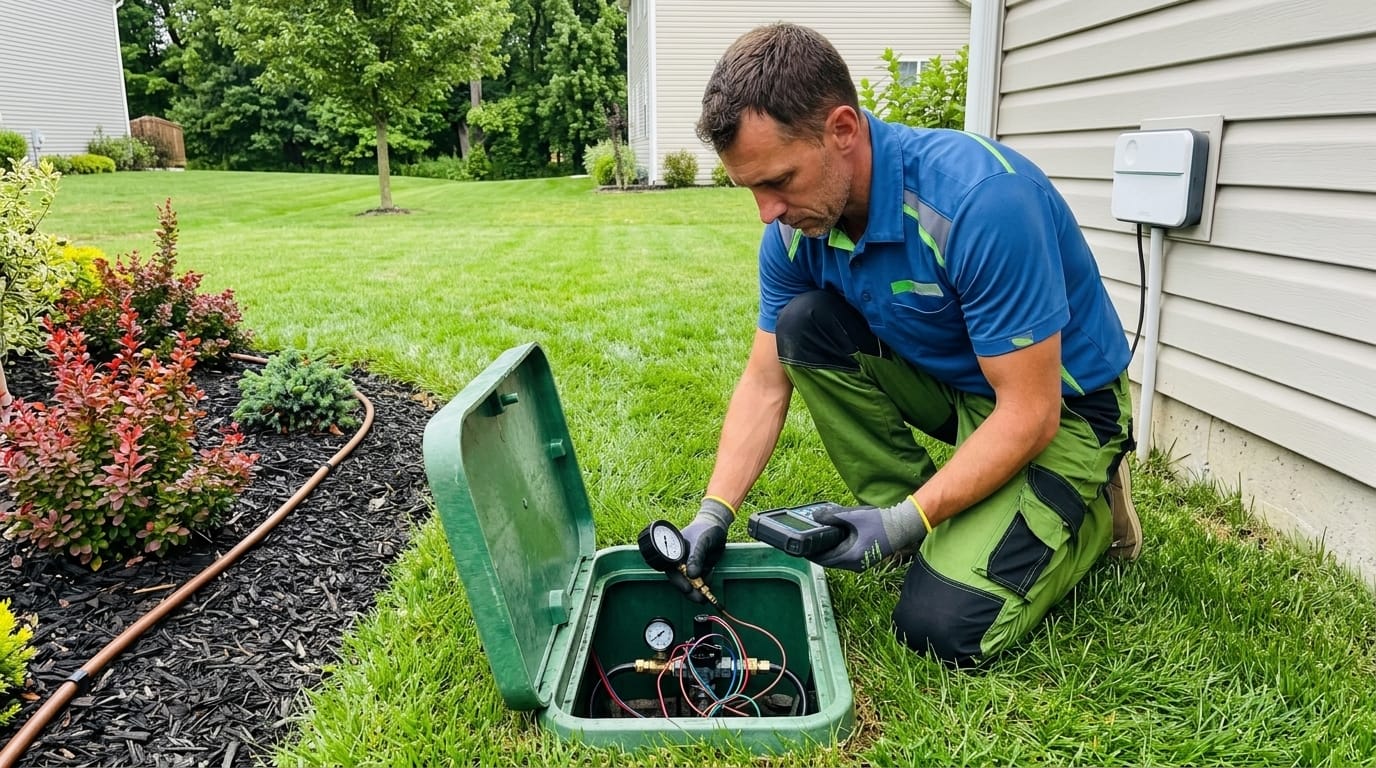
If your meter test confirms an irrigation leak, or if you’re tired of wasting money on inefficient layouts, it’s time to stop guessing. A comprehensive irrigation system inspection can pinpoint broken components, electrical faults, and zone pressure drops in a single visit.
For older systems, solving the problem long-term doesn’t necessarily mean digging up the yard. Targeted sprinkler repair can replace failing zone valves and cracked heads instantly.
If your layout is fine but your technology is ancient, upgrading to seasonal smart WiFi controllers allows your system to automatically adjust its watering run-times based on local Rochester weather feeds. Furthermore, if you are wasting water trying to spray delicate landscape beds with high-pressure rotors, converting those zones to low-volume drip irrigation systems delivers water directly to the roots, cutting evaporation waste down to zero.
Quick Answers
Is it normal for my water bill to rise during the summer?
Yes. Evaporation rates peak in July and August, meaning your lawn naturally requires more supplemental hydration to remain resilient. A higher bill isn’t a cause for panic on its own; a bill that is significantly higher than the previous summer’s statement under similar weather conditions is the real red flag.
How can I locate a sprinkler leak if water isn’t pooling on the lawn?
Look for secondary indicators during a manual zone test. Unusually low water pressure on a specific zone, pop-up heads that fail to extend fully, or an isolated patch of grass that remains damp and vibrant green long after the system shuts down all point directly to a line rupture nearby.
Will a smart controller instantly lower my utility bill?
It will if your current routine involves running a standard dial timer on a rigid, unyielding schedule. Smart controllers pull real-time meteorological data to skip scheduled cycles during local rainfall. However, if your system has a mechanical underground leak, a smart controller cannot fix that the physical pipe must be repaired first.
Is hand-watering with a hose more cost-effective than using sprinklers?
For large turf areas, absolutely not. Hand-watering results in massive water loss due to uneven distribution and immediate surface runoff. Automatic systems utilize precise hydraulic designs to ensure matched precipitation across the entire lawn. The only exception is small, isolated container gardens or flower boxes, where a manual hose or targeted drip line is preferred.